Here’s the thing — price alone tells you almost nothing.
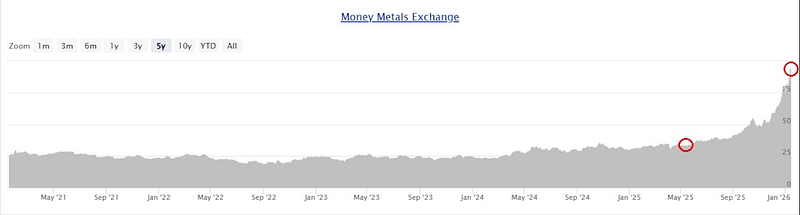
Seven months ago, silver was sitting around $33 an ounce.
It was boring. It was ignored. It was written off as “dead money” by most people who only look at charts through a dollar-denominated lens.
Fast-forward to today and silver is hovering around $90. That’s nearly a 3x move in a matter of months.
A lot of people made real, tangible progress off that move. Not paper gains. Not screenshots. Actual life improvements.
I’ve heard from people who used silver profits to clear credit card debt. Others paid down mortgages. Some simply rebuilt a financial cushion that had been eroded by years of inflation pretending not to exist.
And yet, even now, the most common question I get is:
“Is it too late?”
“Should I hold?”
“Where do you sell?”
That question only makes sense if you’re still thinking in dollars.
I’m not.
I stopped pricing silver in dollars a long time ago, and that shift completely changed how I think about exits, risk, and capital allocation.
Why I Don’t Price Silver in Dollars
The dollar is a moving target. It always has been.
Inflation numbers are revised, redefined, and massaged until they’re unrecognizable. CPI isn’t a real reflection of purchasing power erosion anymore. It’s a political number.
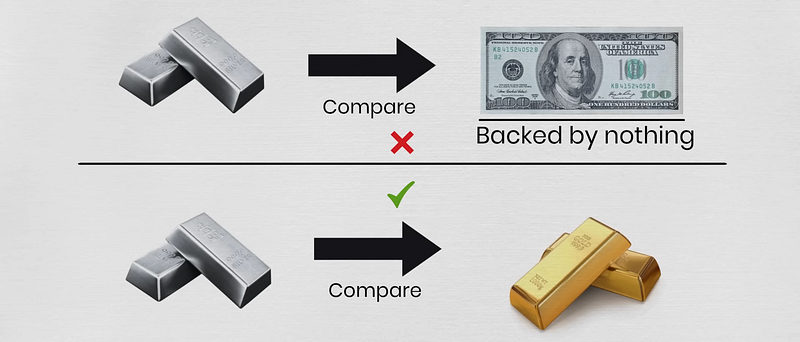
So, pricing silver in USD is like measuring distance with a ruler that changes length every year.
That’s why I price silver against gold.
Gold has survived every currency reset, every empire collapse, every monetary experiment. It’s not perfect, but it’s consistent.
When you compare silver to gold, you remove the noise of fiat debasement and see something far more honest: relative value.
That’s where the gold-to-silver ratio comes in.
What’s The Gold-to-Silver Ratio?
The gold-to-silver ratio is simple:
The price of one ounce of gold divided by the price of one ounce of silver.
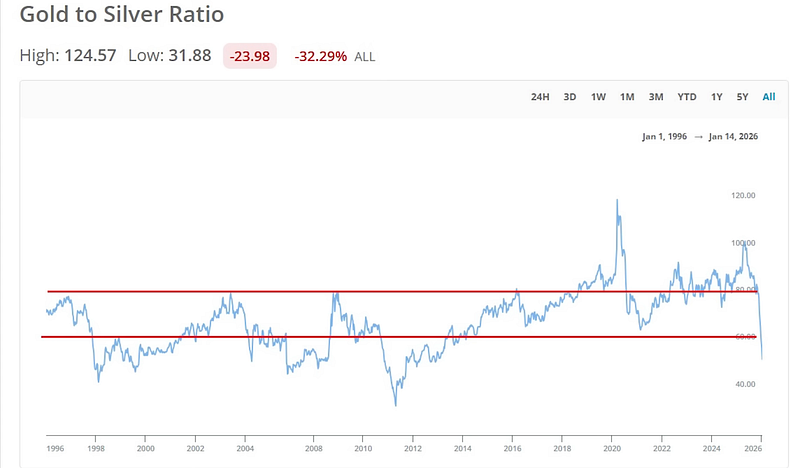
If gold is $3,300 and silver is $33, the ratio is 100. That tells you silver is extremely cheap relative to gold.
Historically, this ratio has lived in a fairly predictable range.
When it sits between 60 and 80, silver is fairly priced. Nothing exciting. Nothing screaming opportunity.
When it pushes above 100, silver is historically cheap. That’s where asymmetry shows up.
That’s where I started buying aggressively.
On the flip side, when the ratio compresses toward 50 or lower, silver is expensive relative to gold. That doesn’t mean silver has to crash. It means risk is shifting.
That’s when I stop thinking like a buyer and start thinking like a capital allocator.
I Started Selling Below a GSR of 50
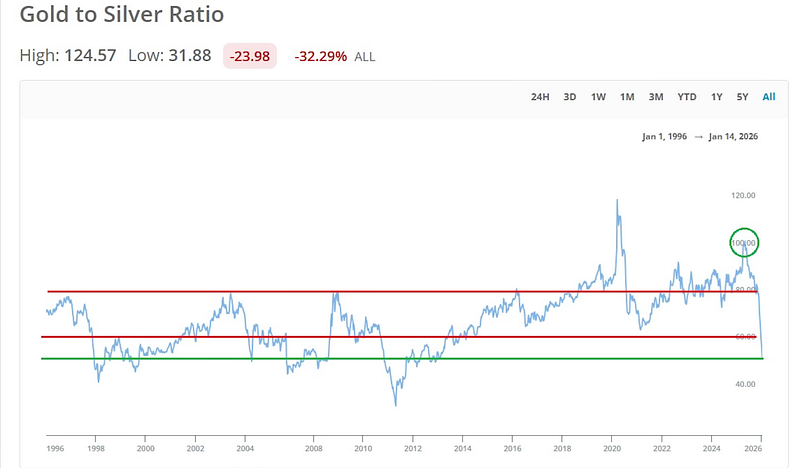
As silver ripped higher over the past several months, the ratio compressed fast.
Very fast.
When it slipped just below 50, I did something that always feels uncomfortable in the moment: I sold.
Specifically, I sold 25% of my paper silver exposure via SLV.
That one move almost recouped my entire original investment.
The rest of the position? That’s now a free roll.
If silver keeps running, I’m still very much in the game. If it chops sideways or retraces, I’ve already removed a huge amount of risk.
This isn’t about calling a top. It’s about removing fragility.
Silver Overshoots, Then Hands the Baton to Gold
One thing silver does extremely well is overshoot. When the gold-to-silver ratio compresses quickly, silver tends to go parabolic.
But history is very clear on what comes next.
After silver has its moment, gold usually outperforms for a while. Not because silver collapses, but because relative value shifts back.
That’s why I don’t marry positions.
Silver and gold move together directionally most of the time.
What changes is who’s leading.
Right now, silver has already led.
That alone doesn’t make me bearish. It makes me selective.
I Sell in Increments (And Buy the Same Way)
I don’t believe in all-in, all-out decisions.
They look heroic on social media and disastrous in real life.
When I buy, I scale in across two to four tranches.
When I sell, I do the same thing on the way out.
That’s not because I lack conviction. It’s because volatility is not your enemy if you respect it.
Selling incrementally smooths regret. It keeps you from freezing if price overshoots higher. It also keeps you from round-tripping life-changing gains because you wanted perfection.
Markets reward discipline far more than brilliance.
Physical Silver Is a Different Asset Entirely
This part matters, and people often blur it.
Paper silver and physical silver are not the same thing.
ETFs like SLV are liquidity tools. They’re fantastic for trading, reallocating, and managing exposure.
That’s why I sell paper first.
Physical silver is different. It’s slower. It’s clunkier.
It’s not optimized for frequent transactions.
And that’s exactly why I hold it longer.
Physical silver is my insurance. It’s my hedge against monetary accidents, not just volatility. If I ever sell physical silver, it will be afterpaper silver is gone. Not before.
The “Great Melt-Up” Isn’t Over — But It’s Not Linear Either
I don’t expect a sudden silver crash.
This entire environment is still defined by excessive liquidity, suppressed rates, and governments that can’t afford austerity.
Asset prices inflate because currencies deflate.
That’s the backdrop.
But melt-ups don’t move in straight lines. They surge, pause, rotate, and reprice risk. That’s why capital allocation matters more than conviction.
I’m still bullish on precious metals. I’m just not blindly bullish on any single expression of that thesis.
I don’t sell because I’m scared.
I don’t hold because I’m attached.
I adjust exposure because the data tells me to.
If the gold-to-silver ratio expands again — say back above 80 or even 100 — I’ll happily buy silver again.
No pride. No narrative anchoring. Just math.
That’s the part people miss. Being bullish doesn’t mean being static.
Final Thoughts
Selling 25% of my silver when the gold-to-silver ratio dipped below 50 wasn’t a call that silver is “done.” It was a decision to respect relative value.
It locked in gains. It reduced risk. It gave me flexibility. The rest of my position can now breathe.
I’m still invested. I’m still bullish on precious metals long-term. I’m still deeply skeptical of fiat currencies and the policies propping them up.
But I’m no longer hostage to one outcome. That’s the real goal — Not being right. Not catching the exact top. But staying solvent, rational, and positioned — no matter what the next chapter looks like.