I told you so.
Don’t mind me saying this — I’ve been warning about this massive liquidation event for weeks.

And here it is — the biggest one we’ve ever seen.
This isn’t just another correction or a routine “buy-the-dip” moment. This is what happens when global geopolitics meets the most leveraged, emotionally charged market on the planet: crypto.
President Trump’s shocking announcement of a 100% tariff on Chinese goods, combined with sweeping new export controls, sent an immediate shockwave through financial markets.
Gold soared. Stocks cracked. But crypto? Crypto got absolutely wrecked.
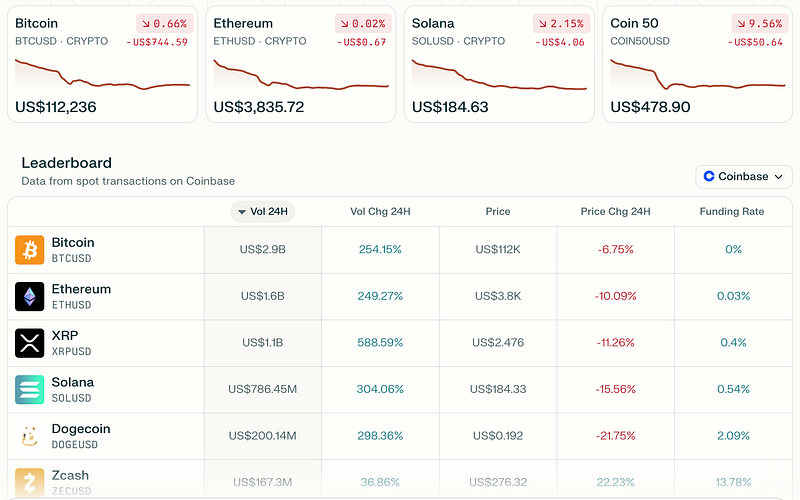
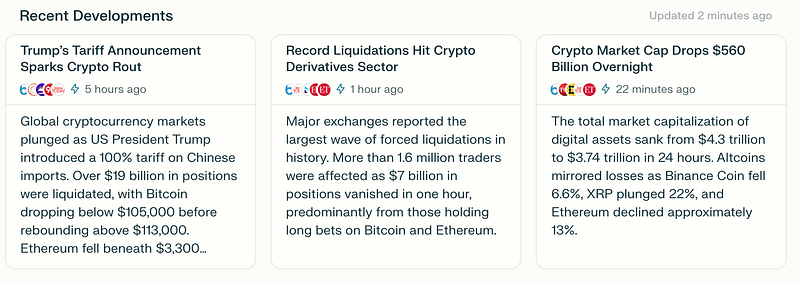
Over $19 billion in crypto positions were liquidated within 24 hours — a bloodbath unlike anything we’ve seen before.
More than 1.6 million traders were forced out of their positions as cascading liquidations rippled across exchanges.
This wasn’t random. It wasn’t unpredictable. It was textbook chaostriggered by leverage, panic, and fear.
And if you’ve been following my updates, you knew this was coming.
Now, let’s break down exactly how it all went down — and more importantly, what happens next.
Massive Liquidation Event — Driven by Tariffs
This happens every time. You’d think that things are unrelated but these are what are called black swan events. Some or the other event collapses the buildup that’s been happening in the crypto space.
The Open Interest Prior to this event was insane.
The whole thing was showing huge cracks.
Trump’s tariff bombshell dropped like a grenade in the whole thing
He didn’t just raise tariffs — he doubled them.
A 100% tariff on Chinese imports, layered on top of existing 30% levies, effectively ignited fears of a renewed U.S.–China trade war.
Markets hate uncertainty — and this was the definition of it.
Traders immediately pulled out of high-risk assets, and crypto — the riskiest of them all — felt the brunt of it.
Within hours, over $19 billion in leveraged crypto positionsevaporated.
Exchanges saw record volumes of forced liquidations as cascading stop losses triggered one after another.
The market entered free-fall mode.
And in that moment, everything that could go wrong — did.
Crypto derivatives markets, already a leverage powder keg, went into a chain reaction.
Once the first domino fell, millions of traders across Binance, OKX, and Bybit watched their positions vanish in seconds.
It was the largest liquidation event in crypto history.
Bitcoin was Volatility on Steroids
Let’s talk about Bitcoin (BTC) — the core of the crypto market.
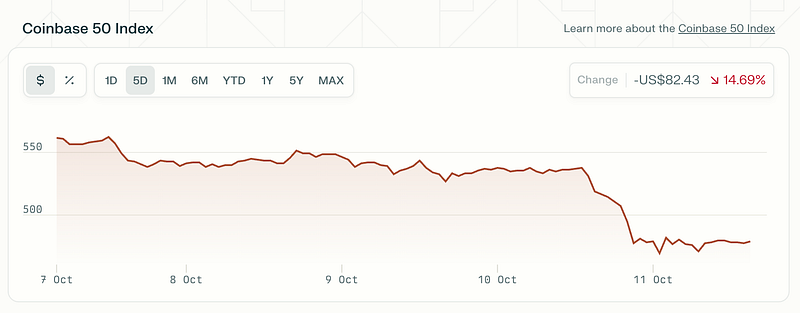
From its recent all-time highs above $126,000, Bitcoin tanked to a gut-wrenching low of around $102,000.
That’s a $24,000 crash — in less than 24 hours.
Longs got obliterated. Shorts took over.
And yet, as brutal as it was, Bitcoin did what it always does — it showed resilience.
After the crash, BTC clawed its way back to $112,000, proving once again why it’s the king of the jungle.
This wasn’t just a random dump — it was the perfect storm of forced liquidations and panic selling from big institutions.
Analysts estimate that over 80% of BTC futures open interest was wiped out during the crash.
But here’s the interesting part: the rebound wasn’t driven by retail panic buyers.
It was institutional traders — the same ones who caused the selloff — re-entering at the lows, hunting for liquidity.
Ethereum Takes a Hit but Holds Its Ground
Now let’s talk about Ethereum (ETH) — the second-largest crypto by market cap and arguably the backbone of DeFi.
ETH fell even harder in percentage terms, dropping over 13% to below $3,400.
Liquidations piled up fast, especially on leveraged positions tied to staking and perpetuals.
But even in the midst of the bloodbath, one thing stood out — institutional conviction remained strong.
Citigroup actually raised its year-end price outlook for Ethereum, citing the asset’s growing appeal for institutional yield strategies.
They highlighted ETH’s role in staking and DeFi protocols as a “sustainable yield vehicle,” noting that this could attract billions in fresh inflows once the dust settles.
So while traders screamed panic, big money was quietly loading up.
Ethereum’s fundamentals didn’t change — only the sentiment did.
XRP — Just Flash Crash
If there’s one chart that perfectly captures chaos, it’s XRP.
The token saw a 42% flash crash, tumbling to $1.64 before rebounding to around $2.40.
Why?
Whale dumping — plain and simple.
Large holders offloaded nearly $50 million worth of XRP/day, triggering a supply glut that drove the price into freefall.
At the same time, open interest in XRP futures collapsed, amplifying volatility.
But once again, opportunistic institutions stepped in.
Big money bought the dip, scooping up XRP at discounted prices and triggering a sharp recovery.
It’s a reminder that in this market, whales don’t just move the price — they control it.
Altcoins: Nothing but Collateral Damage in a Risk-On Super Leaveraged Market
When risk appetite becomes that high and then takes a hit like that, altcoins are always the first to bleed.
And this time, biggest Solana (SOL) took the biggest hit, crashing more than 18% in a single day.
At one point, SOL fell below $137, wiping out weeks of bullish momentum.
The broader altcoin market followed suit, with heavy losses across Avalanche, Chainlink, and Cardano.
Why? Because leveraged traders were forced to liquidate their alt positions first — they’re more volatile, less liquid, and easier to dump.
What we saw was a textbook risk-off rotation — traders running back to Bitcoin, cash, and stablecoins.
But if you look past the panic, you’ll notice something interesting: most alt projects are still fundamentally strong.
The selloff wasn’t driven by weak fundamentals — it was forced by leverage and fear.
Even the so-called “safe” assets weren’t safe this time.
Ethena’s yield-bearing stablecoin USDe briefly lost its peg, crashing to $0.65 before recovering.
Yes, a stablecoin that’s supposed to be worth $1 dropped 35%.
The reason?
Synthetic yield mechanisms tied to volatile collateral.
As prices crashed and collateral value plunged, the peg slipped.
Thankfully, it recovered — but the incident was a wake-up call.
Stablecoins aren’t immune to systemic stress, especially those relying on high-risk, high-yield models.
The takeaway?
There’s no such thing as “risk-free.”
The Bigger Picture
Let’s zoom out.
This liquidation wasn’t just about geopolitics — it was about leverage and weak hands.
Trump’s 100% tariff announcement reignited fears of a long, grinding U.S.–China trade war.
And when you combine trade tension with export bans on advanced technology and software, you get a recipe for global panic.
Traditional markets like equities and commodities sold off sharply.
Gold hit new all-time highs.
And crypto? It became the punching bag of macro volatility.
Investors rushed into U.S. Treasuries and gold, leaving risk assets like Bitcoin gasping for air.
Volatility indexes spiked, and for the first time in months, Bitcoin’s correlation with traditional risk assets broke down.
The message was clear — when the macro world sneezes, crypto catches pneumonia.
Amid the chaos, something profound is happening.
Institutions are no longer treating crypto like a speculative casino.
They’re differentiating between assets with utility and those driven purely by hype.
Citigroup’s bullish note on Ethereum wasn’t random — it’s a reflection of this shift.
Institutions are hunting for yield-driven assets — staking, real-world asset (RWA) protocols, and DeFi products that can generate consistent cash flows.
The market is maturing, even in chaos.
That’s why we’re seeing the smartest investors reallocate into assets that survive volatility rather than chasing short-term pumps.
And this, ironically, could become the very foundation of the next bull run.
Conclusion: The Storm Was Inevitable — and Healthy
Let’s be honest — this was brutal.
Billions wiped out. Millions liquidated. Fear everywhere.
But guess what? It was necessary.
Markets need to reset. Leverage needs to flush out. Weak hands need to go.
This liquidation, as ugly as it was, is part of crypto’s natural cycle.
Every bull run in history has a moment like this — a sharp, gut-wrenching correction that wipes the slate clean before the next leg higher.
We just witnessed that moment.
The key takeaway?
Crypto is more tied to global events than ever before. Tariffs, trade wars, and macro liquidity shifts all matter now.
But the fundamentals — institutional adoption, Ethereum’s yield growth, Bitcoin’s dominance — remain strong.
So yes, this was the largest liquidation event in history.
Yes, it was ugly.
But it’s also setting the stage for one of the biggest rebounds we’ve ever seen.
The storm has passed. The weak have been flushed out. Yes that’s a healthy sign. Yes that means we have bottomed atleast in thes hort term because there is noone with weak hands left to sell as they’ve all gotten liquidated. All that remains are spots holders. So the whole market will now consolidate over the weekend. And I do think this can be the start of the next bear — just like what happened the last black swan during the FTX collapse.
You don’t have to believe or even agree with me — but I’d urge —
Just watch out.