
Over the past few months, I’ve had to unlearn a lot of comfortable assumptions about how crypto markets are supposed to behave.
For years, we’ve been trained to think in clean cycles: Bitcoin leads, Ethereum follows, altcoins explode, and then everything resets.
But what I’m seeing now doesn’t fit that template at all.
The current crash is different. Not just because prices are down, but because the structure underneath the market has shifted. When I started digging into on-chain data, macro correlations, and capital flows, it became clear that this isn’t just another dip or even a standard bear market.
It’s a transition period where old narratives are breaking down, and new ones haven’t fully formed yet.
And Ethereum — more than Bitcoin — is sitting at the center of that shift.
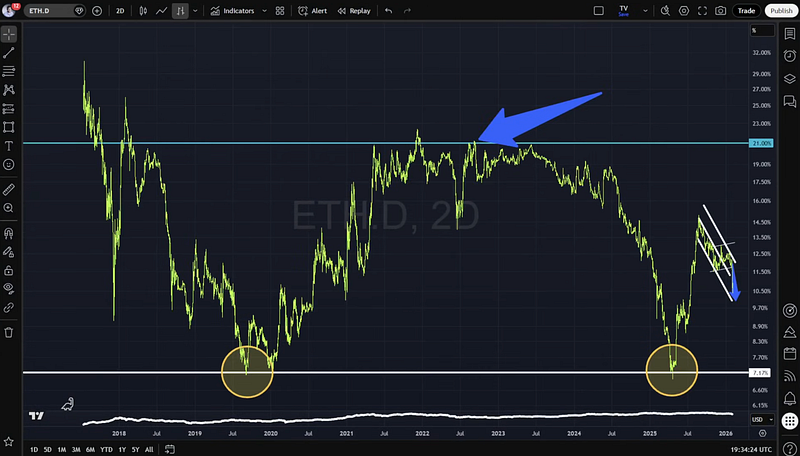
Ethereum Isn’t Just Underperforming — It’s Actively Dragging the Market Down
I don’t think the current crypto drawdown can be understood without addressing Ethereum directly.
Ethereum’s crash isn’t incidental — it’s foundational to what’s happening across the market.
One thing that really stood out to me was the narrative shift coming directly from Vitalik himself.
When the person who architected the original Layer 2 vision publicly says that it “no longer makes sense,” that’s not a small signal. That undermines years of bullish assumptions around scaling, rollups, and long-term Ethereum ecosystem growth.
Markets run on belief as much as data. And when that belief cracks at the core, price tends to follow.
This Ethereum weakness isn’t happening in isolation either. Crypto has become tightly coupled to technology stocks, especially the NASDAQ 100. As tech has deleveraged, crypto has followed almost step for step.
But Ethereum is amplifying that move. When ETH sells off, it doesn’t just affect ETH holders — it mechanically pressures the entire altcoin market.

The Stablecoin Signal Most People Are Ignoring
One of the most underappreciated indicators right now is the relationship between stablecoin market cap and the broader money supply.
I keep coming back to this because it explains why rallies keep failing.
Stablecoins are effectively the on-ramps for new fiat entering crypto. When stablecoin supply grows, it usually means fresh capital is flowing in, setting the stage for sustainable bull markets.
But since October 2023, the stablecoin market cap has gone flat relative to US M2. No growth. No expansion.
That’s a massive red flag.
Without new fiat inflows, every rally becomes a redistribution event — someone else’s exit liquidity. And that’s exactly what the data shows. The crypto market cap excluding stablecoins is down roughly 42%, which tells me this isn’t just price volatility — it’s capital leaving the system.
This crash is partially self-inflicted through Ethereum’s structural issues, but it’s also being driven by broader macro deleveraging.

Bitcoin Is Lagging
Underneath Bitcoin, the same pressures are at work.
When I look at Bitcoin HODL waves, the long-term trend is still constructive. Coins that haven’t moved in five years or more keep increasing, which supports Bitcoin’s long-term appreciation story.
But medium-term holders — the 2-to-5-year cohort — are behaving exactly how they always do. They sell into strength.
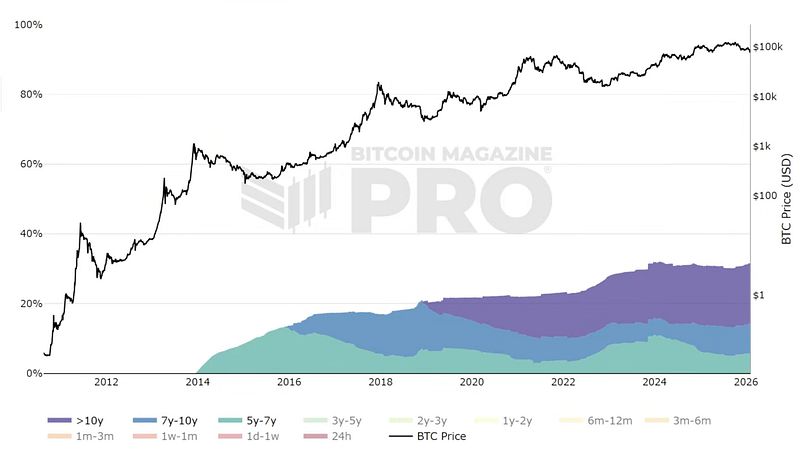
What’s different this time is that they started selling aggressively after Bitcoin pushed through the $40K area, and they haven’t meaningfully stepped back in yet.
That matters.
Historically, Bitcoin bear markets don’t end until this cohort becomes net buyers again. Right now, they’re still distributing.
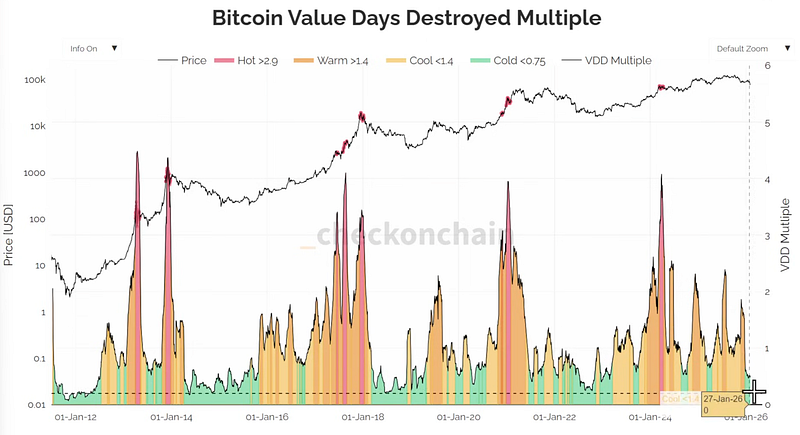
Another thing I want to stress is that this crash is not being driven by OG Bitcoin holders dumping their bags. Value Days Destroyed confirms that long-dormant coins aren’t suddenly waking up.
This isn’t a generational exit. It’s a market structure problem.
Based on historical behavior, Bitcoin’s long-term holder realized price sits around $40K, and bottoms tend to form roughly 25% below that. That puts a statistically plausible bottom near $30K if conditions deteriorate further.
I’m not predicting that level — but I can’t ignore the math either.
Why Altcoins Are Weak — and Why That Probably Won’t Change Soon
Here’s the uncomfortable truth most people don’t want to hear.
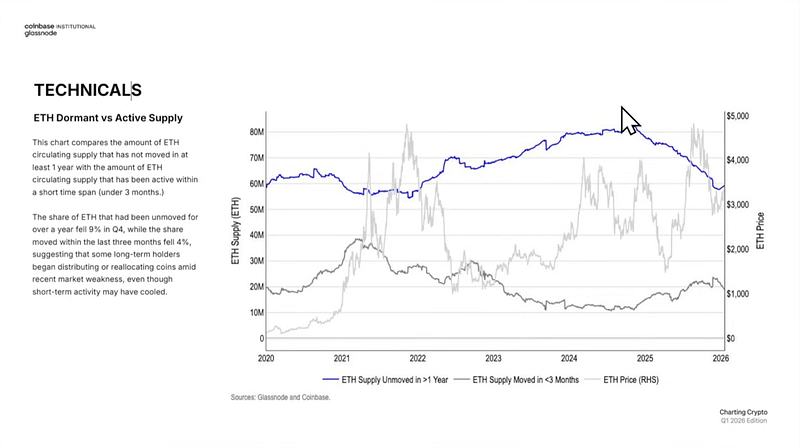
Altcoins don’t really trade against USD. They trade against Ethereum.
Most liquidity pools, pricing mechanisms, and capital rotations are ETH-based. So when Ethereum falls, altcoins fall by design.
This is why altcoin market cap relative to Ethereum has been declining for years. Each “altseason” has been weaker than the last.
And I don’t think that’s accidental.
Institutional adoption has fundamentally changed the market. ETFs, treasury purchases, and regulatory clarity favor Bitcoin first and Ethereum second. Retail-driven alt rotations — the kind that fueled previous altseasons — are becoming less relevant.
That doesn’t mean altcoins can’t pump. It means those pumps are increasingly short-lived and fragile.
In bear markets, my framework is simple:
Short altcoin pumps.
Buy altcoin dips only in confirmed bull markets.
Trying to do the opposite is how portfolios get destroyed.
The Macro Problem No One Wants to Address
Zooming out, the bigger issue isn’t crypto-specific.
We’re dealing with capital concentration and leverage buildup across markets. Stock indices are delivering 9–10% annual returns while GDP grows at roughly 3%.
That gap doesn’t come from productivity — it comes from credit expansion and financial engineering.
This works until it doesn’t.
S&P 500 valuations are stretched. Tech and AI stocks are priced for perfection. And crypto, now deeply correlated with tech, sits right in the blast radius if that bubble deflates.
Even traditional “safe” assets have limits. There isn’t infinite capacity for everyone to hide in gold or government bonds. Sometimes the real rotation is simply into cash.
That’s not bullish — but it is realistic.
How I’m Actually Approaching This Market
I don’t rely on vibes or narratives. I rely on back-tested indicators.
Moving averages, stablecoin growth, and NUPL metrics give me objective signals about trend direction and risk.
My core philosophy hasn’t changed:
Buy dips in bull markets.
Short pumps in bear markets.
Right now, the price is below key moving averages. Stablecoin supply isn’t expanding. NUPL shows investors are still meaningfully in profit.
That’s not a bottom environment.
I’ve been bearish since October 2025 and positioned accordingly.
I only buy crashes if they’re violent and historically extreme — 20–30% in a single day. Slow, grinding sell-offs are where capital gets trapped.
Portfolio Construction Matters More Than Predictions
One thing I’ve learned the hard way is that expected returns are mostly a fantasy. Past performance doesn’t translate cleanly into the future.
What actually matters is:
Risk tolerance.
Income relative to net worth.
Diversification across uncorrelated assets.
Crypto and tech are no longer uncorrelated. That means portfolios need real diversification — precious metals, bonds, real estate, even collectibles.
And most importantly, you need an edge.
If you’re going to trade actively, accept that even top traders barely exceed a 50–55% win rate. Luck is always involved. Trading against the trend is usually just ego.
Where This Leaves Me Mentally
I’m cautious. Not pessimistic — but grounded.
Markets don’t owe us upside. They move based on liquidity, incentives, and human behavior.
Right now, the signals say patience matters more than bravado. The best opportunities usually arrive when conditions align — not when we force them.
I’m staying flexible, protecting capital, and waiting for confirmation — not hope.
Because hope isn’t a strategy.
Found this article insightful?
It would mean a lot if you could give it a clap and follow for more financial alpha, which “influencers” are too lazy to study and share.🌟
Follow me on Twitter/X to stay always up to date.🎄