
I keep hearing the same question over and over again.
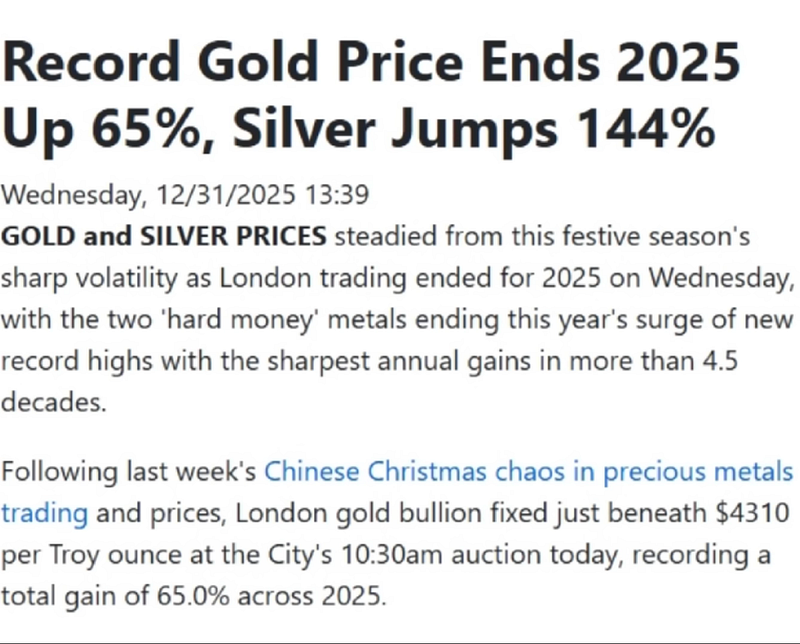
“Gold has already gone up so much — isn’t it too late now?”
And every time I hear that, I realize how badly most people misunderstand why gold is moving in the first place.
They’re looking at the price. I’m looking at the system underneath it.
Gold isn’t rising because of hype, momentum, or speculation. It’s rising because the foundations of the global monetary system are quietly cracking — and once you see that, it becomes very hard to unsee.
Let me walk through how I’m thinking about this.
Inflation Isn’t the Story — It’s the Symptom
Most people start with inflation, and that’s fine, but inflation alone doesn’t explain what we’re seeing.
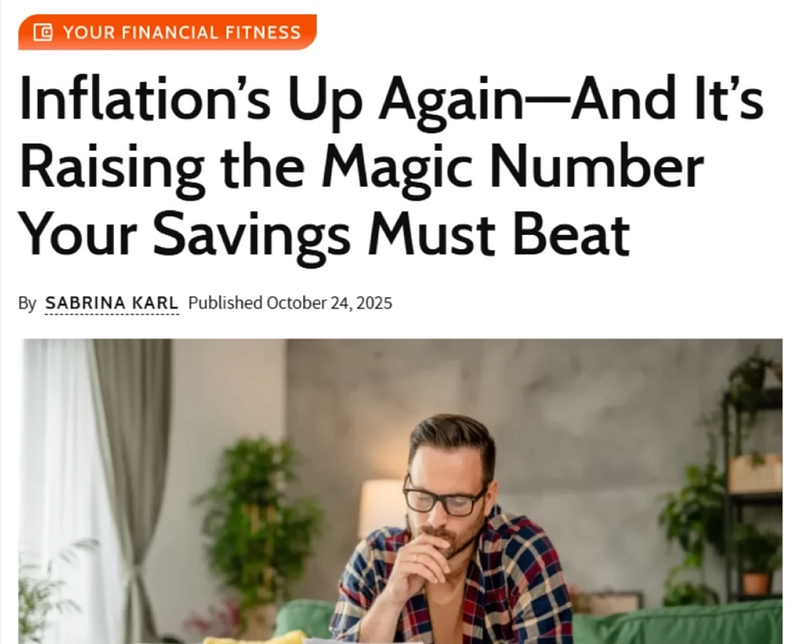
Yes, inflation is high. Yes, it’s running roughly 6–8% depending on how you measure it. And yes, your savings account is paying you maybe 3–4% if you’re lucky.
That means something simple but brutal: You are losing purchasing power every single year by holding cash.
But here’s the deeper issue. Inflation isn’t happening because of supply chain hiccups or greedy corporations.
It’s happening because central banks are printing money at a scale that makes historical comparisons almost meaningless.
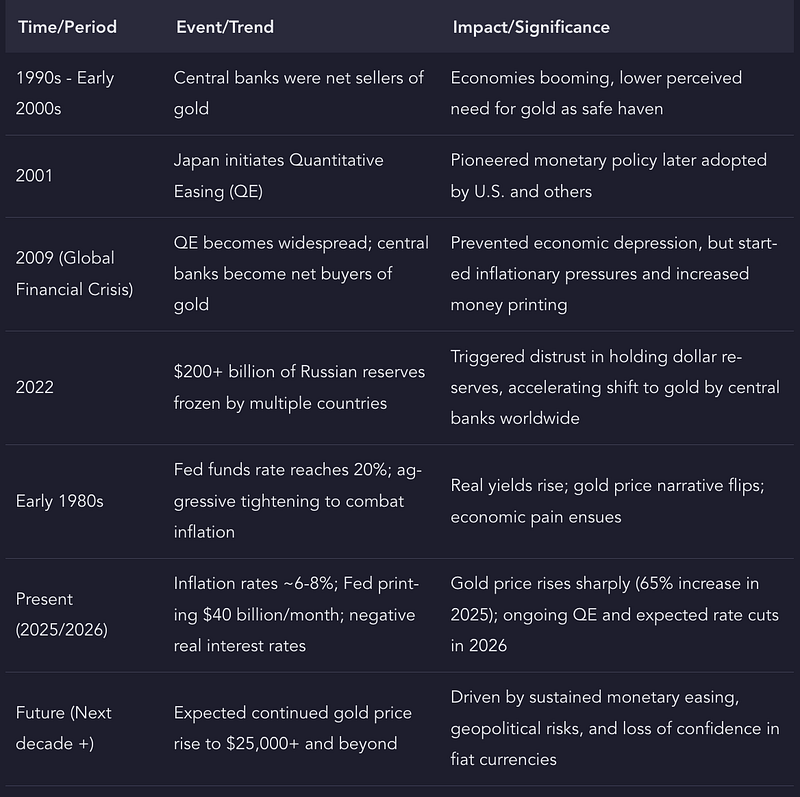
The Federal Reserve alone is still expanding its balance sheet at roughly $40 billion per month. That’s not a temporary emergency measure anymore. That’s the system.
When you increase the supply of money faster than the supply of real goods and services, prices have to rise. Gold isn’t “going up” — fiat currency is being diluted.
Once you frame it that way, the gold chart starts making a lot more sense.
Negative Real Rates Change Everything
One of the most important concepts people overlook is real interest rates.
Nominally, you might earn 4–4.5% on Treasuries. But if inflation is 6–8%, your real return is negative.
That means the so-called “risk-free rate” isn’t risk-free at all. It guarantees a loss in purchasing power.
This is the environment where gold thrives. Gold doesn’t yield anything — but when everything else yields a loss, that suddenly stops being a disadvantage.
People often say, “Why would I hold gold when bonds pay interest?” The correct response today is: “Why would I hold bonds when they guarantee real losses?”
Gold vs. Everything Else
Sure, stocks and real estate can also hedge inflation. But they come with baggage.
Stocks depend on earnings, valuations, and economic growth — all of which become fragile in high-debt, high-rate environments. Real estate comes with leverage, taxes, maintenance, and increasingly political risk.
Gold is brutally simple.
You don’t manage it. You don’t refinance it. You don’t worry about tenants, boards, or regulators.
You hold it. And it holds value.
That simplicity matters more than people admit, especially when systems become unstable.
Central Banks Have Quietly Flipped Sides
This is one of the most underappreciated shifts of the last 20 years.
In the 1990s and early 2000s, central banks were net sellers of gold. The world felt stable. The dollar felt unquestioned. Globalization was expanding.
That changed after 2009.
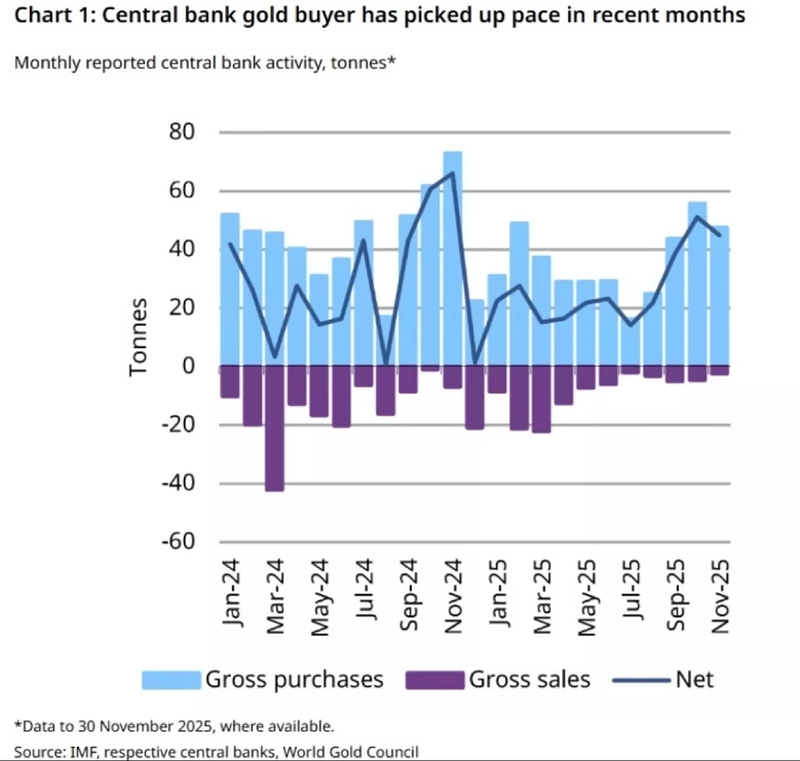
Since the global financial crisis, central banks have been consistent net buyers of gold. Not speculators. Not retail investors. Central banks.
That should tell you everything you need to know.
These institutions see the plumbing of the system. They understand currency risk better than anyone. And they’ve been steadily diversifying away from dollar-centric reserves.
The turning point accelerated in 2022.
The Moment the World Learned Reserves Aren’t Sacred
When over $200 billion of Russian reserves were frozen across multiple countries, something fundamental broke.
It wasn’t about Russia. It was about precedent.
Every central bank around the world learned a hard lesson: Reserves held in someone else’s currency are only yours until they’re not.
Gold can’t be frozen. It can’t be sanctioned. It doesn’t depend on another country’s legal system.
Since then, gold accumulation by central banks hasn’t slowed — it’s intensified. That’s strategic repositioning.
This Isn’t a Normal Gold Bull Market
People love linear thinking. “If gold went from $250 to $1,900 last time, maybe it goes a bit higher this time.”
That completely misses the scale of what’s happening.
The last major gold bull market saw roughly a 7–8x move from trough to peak. And that happened in a world with far less debt, less leverage, and less monetary distortion than today.
Now consider the constraints we’re operating under.
In the early 1980s, the Fed could raise rates to 20% to crush inflation. Today, that’s impossible.
Global debt levels make aggressive tightening politically and economically suicidal. Governments can’t afford high real rates. They need inflation to manage debt burdens.
That means monetary repression becomes policy, not accident.
That’s why I view this as a gold super cycle, not a trade.
Fiat Currency Failure Is a Process, Not an Event
When people hear “fiat currency failure,” they imagine hyperinflation overnight. That’s not how it usually works.
It’s a slow erosion. A loss of confidence. A gradual shift in how people store value.
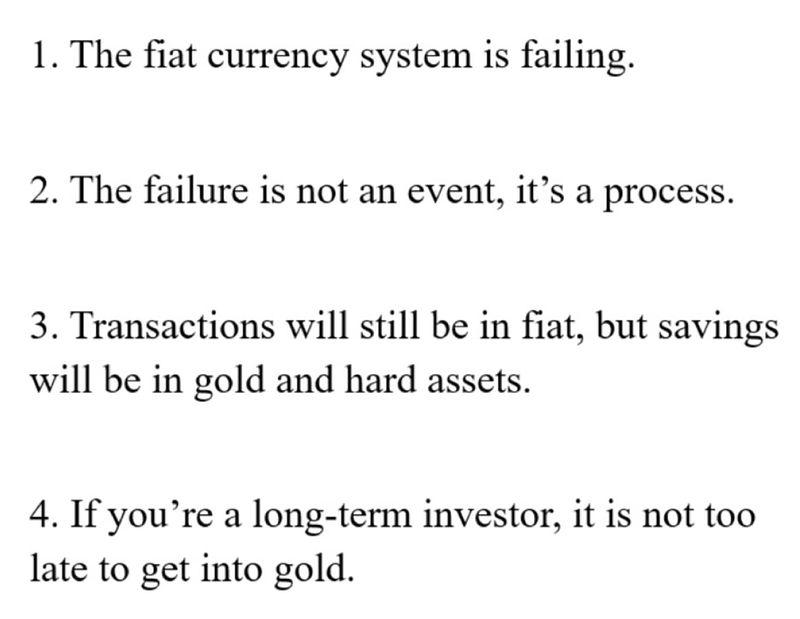
You still use fiat for transactions. You just stop trusting it for savings. That’s exactly what’s happening now.
Gold doesn’t replace money. It replaces trust. And trust, once lost, doesn’t come back easily.
Why I Don’t Think It’s Too Late
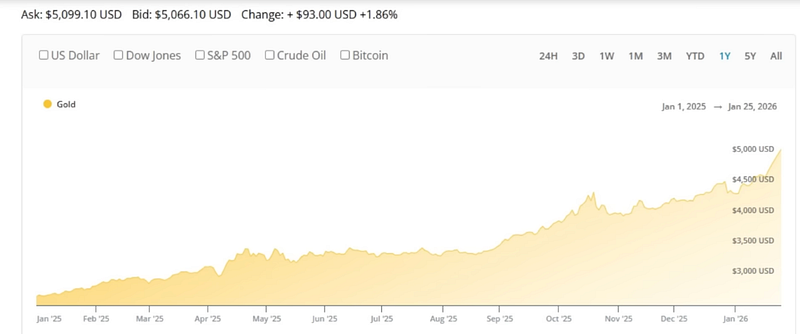
Gold around $5,000 sounds expensive until you zoom out. This move isn’t driven by retail FOMO. It’s driven by:
Persistent negative real rates
Ongoing quantitative easing
Central bank accumulation
Geopolitical fragmentation
Structural debt constraints
None of those have been resolved.
If anything, they’re becoming more entrenched.
That’s why projections of $8,000 during this cycle don’t sound crazy to me.
And why longer-term scenarios of $25,000 or higher aren’t “predictions” — they’re mathematical outcomes if fiat dilution continues.
My Mental Model Going Forward
I don’t think gold is something you trade in and out of aggressively. I think of it as insurance against monetary instability.
I also don’t think fiat disappears. It remains the medium of exchange.
But savings behavior is changing. Quietly. Systemically.
Gold isn’t reacting to headlines. It’s reacting to incentives. And right now, the incentives are screaming one thing: Don’t store long-term value in something designed to be printed infinitely.
Final Thoughts
Gold isn’t rising because people are suddenly emotional. It’s rising because the math no longer works for fiat currencies.
This isn’t about timing tops or bottoms. It’s about understanding what kind of system we’re actually living in.
And once you accept that the experiment of unlimited money meets finite reality — gold stops looking expensive.
It starts looking inevitable.